
Highland Parole and Probation Paths
Probation usually comes from a court order. A Highland County judge may suspend part of a sentence and require supervised probation, including when a person never enters a Virginia Department of Corrections prison. Parole is conditional release from a prison sentence for a person who is legally eligible. The Virginia Parole Board makes the release decision, while VADOC Community Corrections manages supervision in the community. Neither status proves that a person is still in jail.
A person can also leave prison at sentence discharge without parole. Another person may serve a local jail term and then report to Blue Ridge Court Services rather than a state probation and parole district. The label in the actual sentencing, revocation, or release order controls. Start there before calling an office.
| Point | Parole | Probation |
|---|---|---|
| Legal source | Conditional prison release for a legally eligible case | Court sentence, often tied to suspended time |
| Decision maker | Virginia Parole Board | Sentencing court |
| Supervising body | VADOC Community Corrections | VADOC district or local court services, as ordered |
| Best first record | Board decision and VADOC release record | Sentencing or revocation order |
| End point | Discharge or other lawful end of supervision | Court or agency discharge after the ordered term |
- Parole
- Conditional release from confinement before sentence discharge in a legally eligible case.
- Probation
- Court-ordered community supervision that may follow jail time or a suspended sentence.
- Supervisee
- A person managed by a probation or parole office in the community.
- Discharge
- The formal end of a sentence or supervision obligation.
Verify Highland Post-Release Supervision
No single search answers every Highland County parole and probation question. The court order explains what was imposed. The VADOC Inmate and Supervisee Locator may show a person supervised by a district, and the assigned office can confirm what it is permitted to disclose. A missing public result is not proof that supervision ended.
- Identify the Highland court and case. Read the sentencing or revocation order for suspended time, supervised probation, or another supervision term.
- Search VADOC with the seven-digit DOC ID when known. Otherwise use at least the first three letters of the first name and the full last name, then compare identity details.
- Note whether the result describes incarceration, district supervision, or another VADOC category. A supervision result is not a jail roster entry.
- Contact the district tied to the person’s assignment or residence. Give the full name, date of birth or VADOC number when appropriate, and the court case.
- For a local probation placement, contact Blue Ridge Court Services and the sentencing clerk. Do not treat local probation as state parole.
- If parole is claimed, check the Virginia Parole Board’s monthly decisions and then confirm release or supervision with VADOC.
Community supervision proves neither present jail custody nor the exact time a person left MRRJ or a VADOC facility.
The broader Highland County released-inmate search explains how to pair the supervision check with MRRJ, Highland court, and release records. Keep each record in its own role. A court order can authorize release, a jail transaction can document physical release, and VADOC can document state supervision.
Note: Office assignment may follow residence and case management, so a Highland conviction does not guarantee a Highland-based supervision contact.
Highland Supervision at District 12
VADOC research material places Highland County in Staunton Probation and Parole District 12. The district also serves Augusta, Bath, and Rockbridge counties, along with Buena Vista, Lexington, Staunton, and Waynesboro. The live VADOC facilities directory identifies the Staunton office, but its map tooltip has displayed a conflicting list of Winchester-area localities. That mismatch is a reason to call before making a trip, not a basis to discard the official Highland coverage material.
VADOC Probation and Parole District 12134 Rowe Road
Staunton, VA 24401
Phone: 540-332-7780
Chief: Joshua Lutz
Ask whether District 12 is the assigned office for the named person. If the person now lives elsewhere, the case may be managed by another district. Case files are not fully public. Va. Code § 2.2-3706(B)(6) excludes VADOC supervision case files from mandatory disclosure, so a caller should not expect officer details, reporting locations, or every condition.
Highland Local Probation Services
Blue Ridge Court Services is a separate Highland County route. Official city and legislative material says it serves Highland for pretrial services and local probation. Its role must not be merged with VADOC parole. A placement there may show that a court ordered local community supervision, but it does not document when MRRJ completed the physical release transaction.
Blue Ridge Court Services125 S. New Street
Staunton, VA 24401
Phone: 540-886-1008
Use the Highland sentencing order to tell which office was assigned. The clerk can provide the releasable order, while Court Services may limit case-specific information. This division is common in Highland cases: the court record starts in Monterey, confinement may occur at MRRJ in Staunton, and supervision may be handled by a state district or local program based outside the county.
Highland Parole Decisions and Reports
Virginia parole eligibility depends on offense date, statutory category, and sentence history. Va. Code § 53.1-165.1 abolished discretionary parole for most felony offenses committed on or after January 1, 1995, while preserving legal exceptions. Older cases and special categories may still receive Board review. Eligibility permits consideration; it is not a release order.
The Virginia Parole Board posts monthly parole decision reports. Fields can include the DOC number, name, case type, decision and certification dates, grant or not-grant result, reasons or conditions, time served, jurisdiction, sentence, and member votes. A grant authorizes the next process. It is not the timestamp at which a person left a facility.
The source image below comes from the Board’s official monthly parole report index and shows the statewide reporting route used for a Highland County parole check.
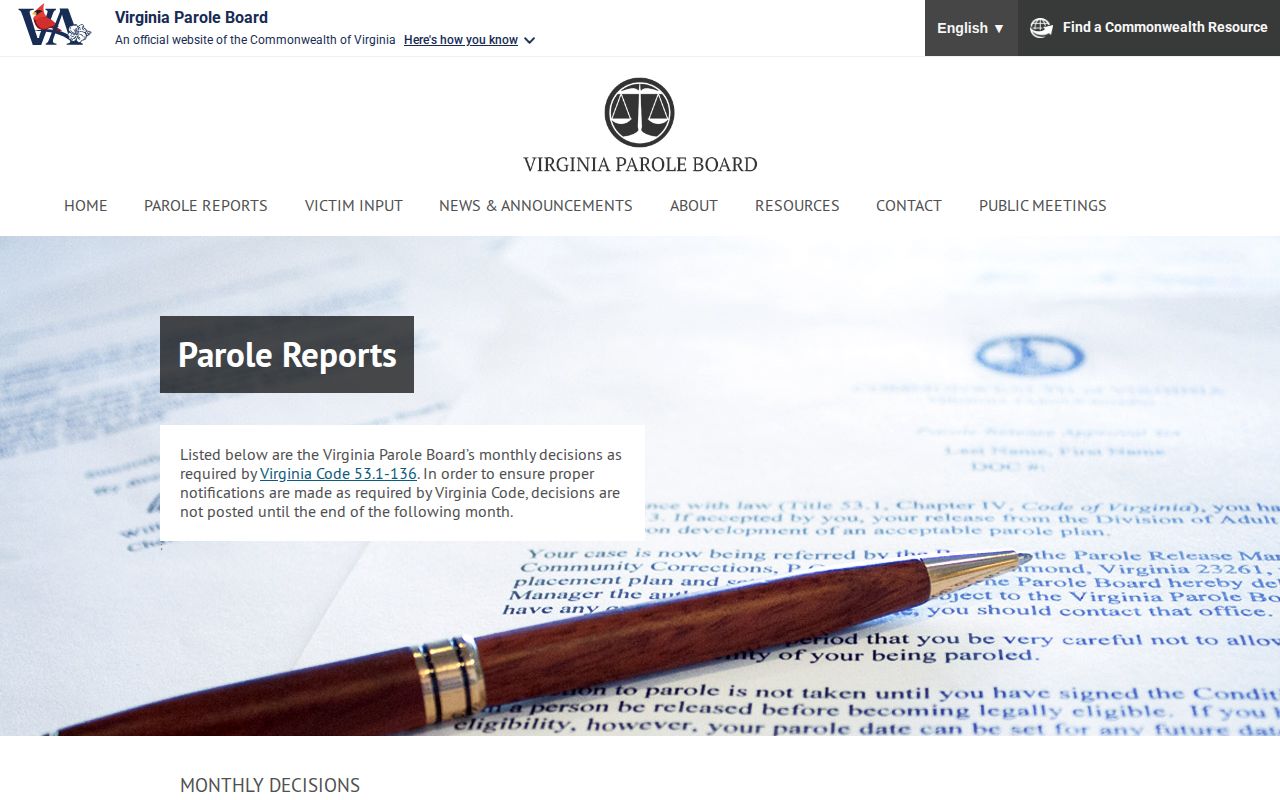
Use the VADOC number to reduce same-name errors, then confirm any grant and later supervision status with VADOC.
For old-law cases, § 53.1-151 contains detailed formulas. First commitments, later commitments, life terms, and specified exclusions do not share one simple date. Section 53.1-153 also addresses certain jail terms and misdemeanor eligibility. Do not calculate Highland County parole eligibility from sentence length alone.
Highland Absconder and Warrant Checks
An absconder is a person alleged to have stopped complying or reporting. The label does not create a new conviction and does not prove present custody. No official Highland County public absconder list was verified. Old news items and third-party entries are not sound proof of current status.
Confirm an alleged supervision violation with VADOC and a warrant with the issuing Highland court or law-enforcement agency. A court docket may show a capias, revocation case, hearing, or order. It still may not show whether another agency has served the warrant. Likewise, absence from a public “most wanted” page is not warrant clearance.
Conditions vary by order and case. At a high level, violations may lead to an agency response, a court filing, a warrant, or a revocation hearing. The public can verify the court event and the supervision agency, but VADOC’s protected case file is not an open log of reporting details. Identity should be checked with a date of birth, case number, or VADOC number, not a matching name alone.
Note: A VINE custody alert may report a jail movement, but it does not replace the court and VADOC checks for supervision status.
Highland Release ID and Property
MRRJ’s inmate handbook adds a local detail to the supervision handoff. Jail-issued property must be returned when a person is released. The jail identification card or band is collected, and the handbook describes a $5 charge when the ID card is not returned. That is a property-control charge. It is not a general Highland County release fee or a condition of parole.
Errors must be sent to the agency that created the field. MRRJ handles its booking and release transaction. The Highland court clerk handles the court order. VADOC handles the state custody or supervision record. A person should identify the exact wrong field and provide the controlling order through the agency’s secure route. One office cannot simply rewrite another office’s source record.
The MRRJ inmate handbook is the source for the ID-card rule, while the jail’s property page explains its property channel. This section addresses the transition out of the jail. It does not show who supervises the person afterward.
Highland Supervision Discharge Records
Supervision ends through the legal process that governs the case. A probation term may end under the sentencing order or a later court action. Parole may end through formal discharge or another lawful Board and VADOC action. Prison sentence discharge can also occur without parole. The exact record should identify the authority and effective date.
For probation, obtain the final or amended Highland court order and ask the assigned office what status it may confirm. For parole, use the Board decision record, the VADOC locator while the person remains publicly searchable, and a VADOC records request when a former supervisee no longer has a useful locator result. Ask for existing release, supervision, and discharge fields rather than a new legal conclusion.
Virginia FOIA does not make the full supervision case file public. A limited public confirmation and a formal court or discharge record may be the strongest available combination. Record the date each source was checked because public status can change after a hearing, transfer, correction, or completed term.